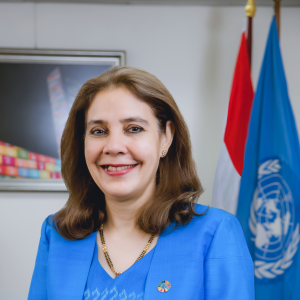
Knowledge Development for Policy Makers: “Introduction of Mobile Positioning Data for Official Statistics” - Resident Coordinator's Speech, Gita Sabharwal
-----
Ibu Pudji Ismartini, Deputy, Methodology and Statistics Information, BPS,
Moh. Edy Mahmud, Acting Principal Secretary and Deputy for National Accounts and Statistical Analysis
Ibu Erni Tri Astuti, Director, STIS Statistics Polytechnic,
Prof Setia Pramana, Vice Director, STIS Statistics Polytechnic,
Participants from the Statistical Offices of Cambodia, Timor-Leste, and the Philippines
Distinguished participants
It is my pleasure to welcome you to this workshop as we accelerate the integration of mobile positioning data into official statistics in Asia and the Pacific.
Let me thank the Indonesian government for hosting this event, which further highlights the country’s leadership on digitization in its capacity as a regional hub on big data and data science.
BPS is showing us how we can leverage mobile positioning data in tourism, urban mobility patterns and other domains to map both scale and granularity in a timely and cost-effective manner.
This points the way forward on harnessing data for broad-based SDG acceleration across the region.
Mobile positioning data (MPD), which is usually generated from mobile phones, provide us with a continuous source of in-depth information for tracking the SDGs.
Such data enable us to monitor progress on individual indicators, identify gaps, and make informed decisions that drive sustainable development.
Unlike traditional surveys, MPD allows us to track human mobility and behavioural trends as they unfold.
This can lend critical support to interventions on public health emergencies, natural disasters and other exigencies.
Mobile phone also opens new opportunities to bring big data to analyse socio-economic conditions with greater precision to uncover hidden patterns and make sound, evidence-based predictions.
For example, mobile phone data can provide data on maternal mortality rates, disease prevalence, and access to health services, especially among vulnerable populations.
Similarly, school enrolment records and education management information systems can track literacy rates, school attendance and educational attainment.
At the same time, business registration data can provide insights into employment trends, economic activity and workforce demographics.
This is critical in today’s fast-changing job markets.
Importantly, however, as we scale up Mobile Phone Data use, we also need to bolster data governance in support of human rights.
This includes robust safeguards for privacy and compliance with national and international data protection regulations.
Also, key is the need to be transparent with people about how their personal data are used.
Upholding data privacy and ethical standards is crucial in today’s increasingly digitized world.
Integrating mobile positioning data and other data collected through mobile phones into official statistics will reshape our understanding of societies and enhance our ability to respond to its evolving needs.
This workshop is an important platform for us to share experiences, flesh out challenges, and co-create a more responsive and data-driven future for our region.
Thank you.


Speech by
Goals we are supporting through this initiative